
Why this turned serious
Two things happened at once. Steel products entering Europe are now priced on their embedded carbon, and automotive OEMs began pushing their own carbon targets down the supply chain. Both hit springs directly, because the overwhelming majority of a spring's footprint sits not in the production line but in the steel itself.
The result: a fourth column appeared in the supplier selection table, next to price, quality and lead time.
CBAM — no longer reporting
The EU's Carbon Border Adjustment Mechanism ran as a reporting-only exercise from late 2023 to the end of 2025. From 1 January 2026 it entered its definitive phase — a financial obligation for the EU importer.
A combined annual threshold of 50 tonnes net mass now applies to iron and steel, aluminium, cement and fertilisers. Importers below it are exempt from all CBAM obligations. Those above it must hold authorised CBAM declarant status, have embedded emissions verified, and purchase certificates. The first declaration covering 2026 imports is due on 30 September 2027.
The critical point is this: the obligation sits with the importer, the data sits with the producer. Your customer in the EU buys the certificates, but the quantity is set by embedded emissions data they will ask you for. A supplier who cannot provide it leaves the customer on default values — and default values are almost always higher than real ones. That is a direct cost disadvantage.
"We're outside the EU, CBAM doesn't concern us" is wrong. CBAM addresses the importer, but the importer factors that cost into supplier selection. Being unable to supply data looks, in practice, exactly like a price increase.
Where the carbon sits in a spring
OEMs increasingly ask for a product carbon footprint per part. For a spring the distribution runs roughly like this:
| Stage | Weight | What decides it |
|---|---|---|
| Steel production | Dominant | Production route — electric arc furnace or integrated mill. The difference is measured in multiples. |
| Heat treatment | Second | Furnace efficiency, energy source, line utilisation |
| Forming | Low | Electricity consumption, line efficiency |
| Coating | Low | Cure oven energy, chemistry selection |
| Logistics | Variable | Distance and mode; sea freight sits far below road |
The practical consequence: the most effective way for a spring maker to improve its footprint is not to optimise its own line but to know and document where its steel comes from and how it was made. A footprint calculated to ISO 14067 or the GHG Protocol and fed by actual supplier data is a different object from an estimate derived from sector averages.
Material declaration and compliance
None of these are new, but enforcement is tightening:
- IMDS — the automotive material declaration system. Full material composition of the part, coating included. Any supplier shipping into automotive should already be doing this.
- REACH — declaration of substances on the SVHC list. The list is updated, so this needs revisiting; it is not a one-off task.
- ELV Directive — restricted substances in end-of-life vehicles. On the spring side the critical heading is hexavalent chromium, which is why older passivation processes were abandoned.
- Recycled content — in steel this follows the production route and is proven by supplier documentation, not by declaration.
If you need an IMDS entry, a material declaration or PCF data, send it through directly.
Talk to our engineersManagement systems
| Certificate | What it tells you |
|---|---|
| ISO 14001 | Environmental impacts are managed systematically. An auditable framework, not a performance figure on its own. |
| ISO 50001 | Energy management. In heat-treatment-heavy production this is a stronger signal than ISO 14001. |
| IATF 16949 | Not environmental, but it means the traceability infrastructure exists — the precondition for reporting carbon data per batch. |
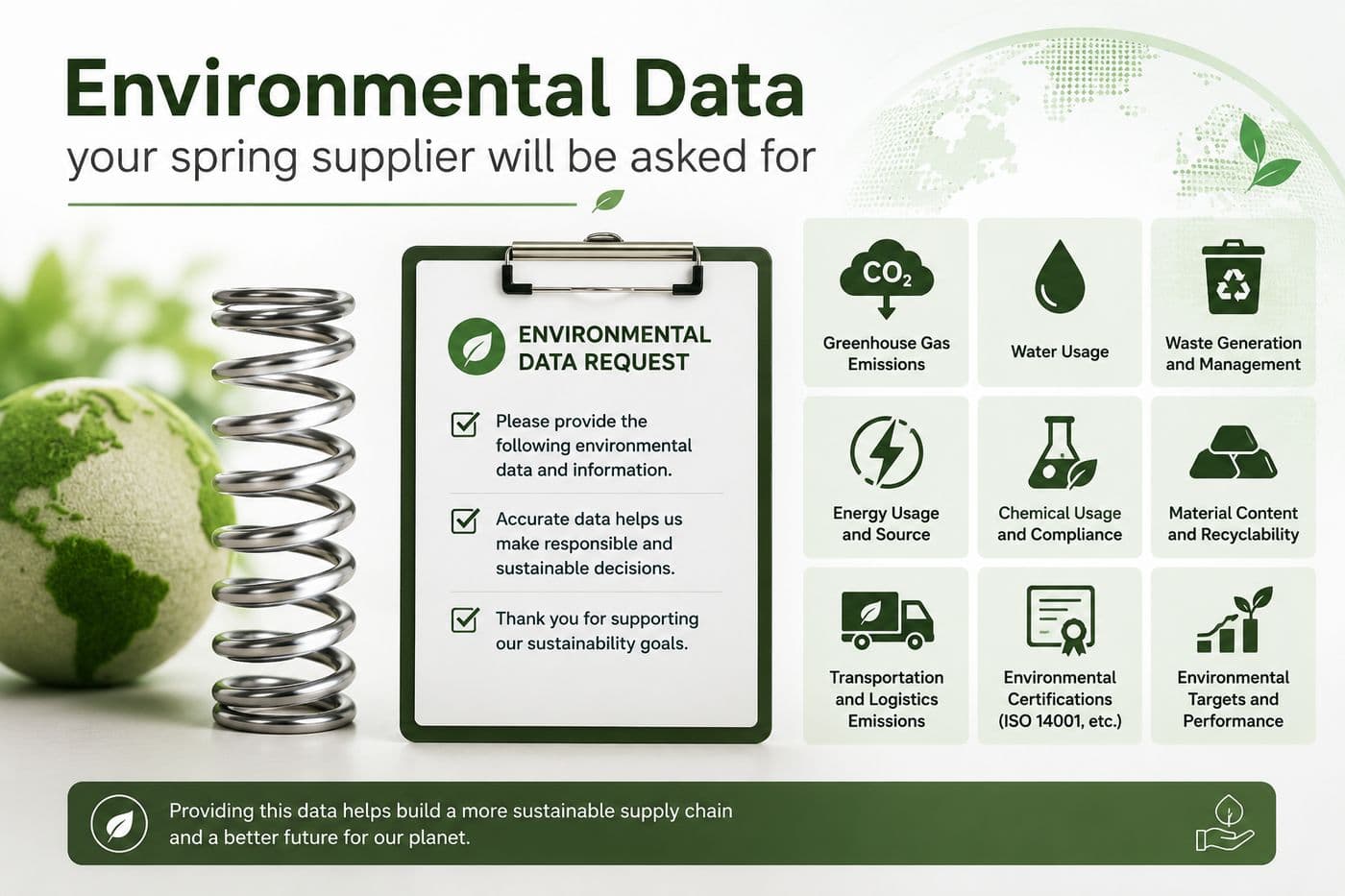
Eight questions for your supplier
Instead of asking for a sustainability deck and receiving thirty PDF pages, ask these eight. How clearly they are answered shows quickly whether the work has actually been done.
- 1Can you provide a carbon footprint per part? To which standard was it calculated?
- 2Do you receive embedded emissions data from your steel supplier, or are you using sector defaults?
- 3What is the production route of the steel you use?
- 4In what format do you supply CBAM data to your EU customers?
- 5Who maintains your IMDS entries, and are they current?
- 6Has hexavalent chromium been fully removed from your coating processes?
- 7Can you track energy consumption per batch or per part?
- 8Is any of this data independently verified?
A good supplier will answer "not yet" to some of these and tell you when it will change. A supplier who answers yes to all eight and produces no documentation is riskier than one who answers no to all eight.
- CBAM entered its definitive phase on 1 January 2026; importers above 50 tonnes a year carry a financial obligation.
- The obligation sits with the importer, the data with the producer. A supplier without data leaves its customer on high default values.
- Most of a spring's footprint comes from the steel; production route is the single biggest factor.
- IMDS, REACH and ELV are not new but enforcement is tightening; Cr(VI) is the critical heading for springs.
- Ask eight concrete questions rather than collecting certificates — the clarity of the answer tells you more than the document.
Editorial note — This article is general information. Formulas, standards and values given here describe established engineering practice and are not a design specification. Any final spring design must be verified against the load case, operating conditions and applicable standards of the individual application. Tenvor Springs accepts no liability for designs derived from this text without such verification.